
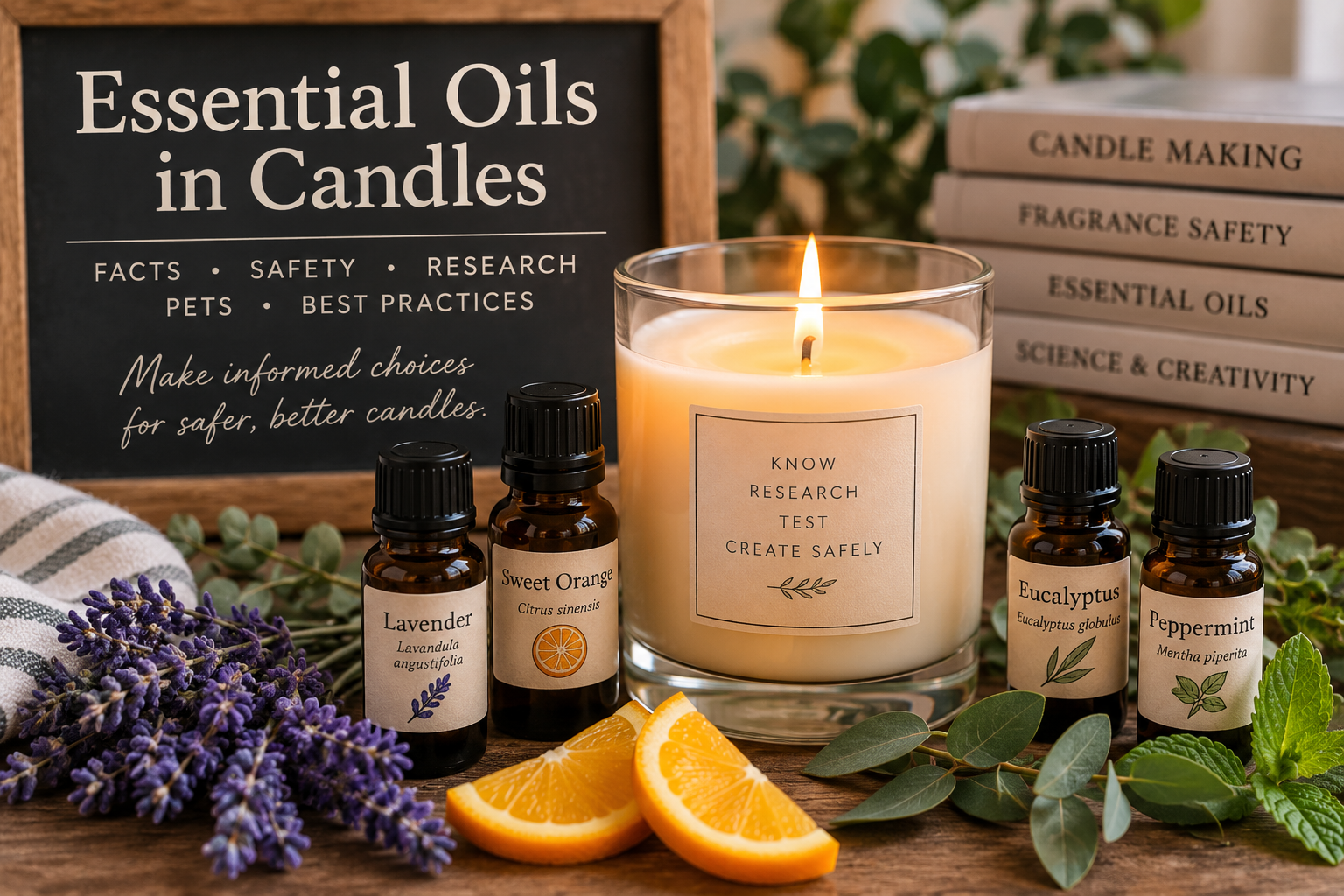
If you spend much time in candle-making groups, you have probably heard this statement:
“Essential oils should never be used in candles because they become toxic when burned.”
But is that actually true?
The short answer is: not exactly.
Essential oils are not automatically safe just because they are natural, but they are also not automatically toxic simply because they are used in a candle.
The truth depends on the individual oil, its chemical makeup, how much is used, and how the finished candle performs.
Essential Oils Are Not All the Same
One of the biggest mistakes is treating all essential oils as though they were one ingredient.
They aren't.
Essential oils are complex mixtures of naturally occurring chemicals. Some oils contain mostly low-concern fragrance compounds, while others contain substances that may be restricted, irritating, sensitizing, or toxic at certain exposure levels.
That means the right question isn't:
“Are essential oils safe?”
It is:
“Is this particular essential oil appropriate for this particular candle at this particular concentration?”
Natural Does Not Automatically Mean Safe
It is easy to assume that essential oils must be safer than synthetic fragrance oils because they come from plants.
That isn't necessarily true.
The FDA specifically warns that “natural” ingredients are not automatically safe. Plants naturally produce chemicals that can irritate skin, cause allergic reactions, or even become toxic under certain types of exposure.
The same principle works in reverse.
A synthetic fragrance ingredient isn't automatically dangerous just because it was created in a laboratory.
What matters most is the actual chemical, the amount being used, and the amount someone is exposed to.
IFRA Recognizes Essential Oils as Fragrance Materials
The International Fragrance Association, better known as IFRA, maintains safety standards for fragrance materials.
Candles are included in IFRA Category 12.
Essential oils are treated as what IFRA calls Natural Complex Substances.
This is important because IFRA does not simply say essential oils cannot be used in candles.
Instead, the chemical components inside the oil must be considered.
If an essential oil contains a restricted ingredient, the amount of that ingredient in the finished candle needs to stay within the appropriate limit.
So the real safety question comes down to the composition of the oil and how much is being used.
What Happens When a Candle Burns?
Another common statement is that essential oils “turn toxic” when they reach a flame.
That description oversimplifies what happens inside a candle.
The wick pulls melted wax upward. The wax and fragrance vaporize near the flame, and those vapors burn.
Some fragrance also evaporates directly from the warm melt pool, which is part of what creates hot throw.
Any burning candle can create combustion byproducts.
That includes:
- Essential-oil candles
- Fragrance-oil candles
- Unscented candles
- Paraffin candles
- Soy candles
- Beeswax candles
The EPA recognizes candles as a source of indoor particulate matter and recommends good indoor ventilation when candles are being burned.
That doesn't mean candles are automatically dangerous.
It means candle combustion, like almost every type of combustion, produces emissions.
What Do Candle Emission Studies Show?
Scientific studies have measured chemicals and particles released by burning candles.
Researchers have detected substances such as particulate matter, formaldehyde, volatile organic compounds, and other combustion products.
But there is an important difference between detecting a chemical and being exposed to enough of that chemical to cause harm.
A large 2021 candle-emissions study measured both scented and unscented candles. Most calculated indoor exposure levels were below established health guidance values under the conditions studied.
Researchers did identify some exceptions under certain circumstances, which is another reason ventilation and proper candle design matter.
There has even been research specifically studying candles made with essential oils.
A 2026 study tested a paraffin candle containing 6% lavender essential oil and measured its emissions under different ventilation conditions.
The research showed measurable combustion products, but it did not conclude that lavender essential-oil candles were inherently toxic.
One of the strongest findings was something candle users should already be practicing:
Ventilation makes a difference.
Some Essential Oils Deserve Extra Caution
This is where the conversation becomes more complicated.
Some natural fragrance materials have legitimate safety concerns.
For example, IFRA prohibits certain materials from fragrance use entirely.
Costus Root Oil
Costus root oil is prohibited by IFRA because of its strong skin-sensitization potential.
American Wormseed Oil
Also known as Chenopodium oil, this is another natural fragrance material prohibited by IFRA.
Crude Cade Oil
Crude cade oil can contain problematic polycyclic aromatic hydrocarbons, or PAHs.
IFRA does not allow crude cade oil as a fragrance ingredient.
Properly rectified cade oil may be allowed only when it meets specific purity requirements.
Safrole-Containing Oils
Safrole can naturally occur in materials such as sassafras.
IFRA places strict limits on safrole and related compounds in finished fragrance products.
Pennyroyal
Concentrated pennyroyal oil has caused severe poisoning and even death when swallowed.
That doesn't mean burning a pennyroyal candle creates the same exposure, but it clearly shows why “natural” should never be confused with “harmless.”
Wintergreen
Wintergreen oil contains a very high amount of methyl salicylate, a chemical related to aspirin.
Concentrated wintergreen oil can be extremely dangerous if swallowed, particularly by children.
Once again, ingestion is not the same exposure as burning a candle, but this is an essential oil that deserves careful handling and professional safety evaluation.
What About Essential Oils and Pets?
This is probably one of the most confusing parts of the essential-oil discussion.
Essential oils absolutely can poison pets under certain circumstances.
Cats are especially vulnerable to some essential oils because they process certain chemicals differently than humans and dogs.
Serious poisonings usually involve situations such as:
- An animal swallowing essential oil
- Essential oil getting onto the skin or fur
- Spilled concentrated oil
- Highly concentrated airborne exposure
- Certain types of active essential-oil diffusers
But there is an important distinction.
The Merck Veterinary Manual specifically identifies candles as passive diffusers.
Passive diffusers do not spray tiny droplets of essential oil into the air the way ultrasonic or nebulizing diffusers can.
For normal passive diffusion, Merck states that the main concern is generally respiratory irritation, assuming the concentrated oil is not spilled, ingested, or applied directly to the animal.
That does not mean every essential-oil candle should be advertised as “pet safe.”
Pets with asthma or other respiratory conditions may be especially sensitive to fragrances.
Oils Commonly Associated With Pet Poisoning
Veterinary sources identify a number of essential oils that have been involved in poisoning incidents in cats or dogs, including:
- Tea tree
- Wintergreen
- Sweet birch
- Eucalyptus
- Pennyroyal
- Cinnamon
- Pine
- Peppermint
- Citrus oils
- Clove
- Ylang ylang
Most serious reports involve concentrated exposure rather than normal candle use.
Still, these oils deserve additional caution in homes with pets.
Birds Need Even More Caution
Birds are especially sensitive to airborne contaminants.
Their respiratory systems are extremely efficient, which unfortunately also means they can be more vulnerable to fumes, aerosols, smoke, and airborne particles.
Veterinary sources recommend being particularly cautious with fragrances around birds.
Because all candles produce some combustion particles, the safest approach is to avoid burning scented candles in the same enclosed airspace as pet birds.
That applies to essential-oil candles and fragrance-oil candles alike.
Flash Point Does Not Tell You Whether an Essential Oil Is Safe
Candle makers often look at an essential oil's flash point and assume that a low flash point means the oil cannot be safely used in a candle.
That isn't what flash point tells us.
Flash point measures when a liquid produces enough vapor to become ignitable under specific test conditions.
It is mainly useful for understanding flammability, storage, transportation, and handling.
Flash point does not tell you:
- Whether the oil is toxic
- Whether it meets IFRA limits
- How much should be used in a candle
- Whether the finished candle will burn safely
Those questions have to be answered separately.
Fragrance Oils Aren't Automatically Safer—or More Dangerous
Another mistake is putting essential oils on one side and fragrance oils on the other.
Modern fragrance oils may contain:
- Synthetic aroma chemicals
- Essential oils
- Natural isolates
- Botanical extracts
- Combinations of natural and synthetic ingredients
A professionally formulated fragrance oil may actually make compliance easier because the fragrance manufacturer can provide an IFRA Certificate for the finished fragrance mixture.
Essential oils can also be used responsibly, but the candle maker may need more detailed information about the natural oil's individual chemical components.
Can Essential Oils Be Used Safely in Candles?
Based on the scientific and regulatory information available, the answer is:
Yes, some essential oils can be appropriate for use in candles when they are properly evaluated, properly formulated, and properly tested.
That does not mean every oil belongs in a candle.
A candle maker using essential oils should ideally know:
- The exact botanical oil being used
- Its chemical composition
- Whether it contains restricted IFRA constituents
- The allowable concentration for candles
- The supplier's SDS and technical information
- Whether the final candle burns safely
And proper burn testing remains essential.
An ingredient can meet fragrance-safety limits and still cause a candle to:
- Soot excessively
- Develop an unstable flame
- Overheat the container
- Mushroom badly
- Perform poorly with a particular wick
- Produce unacceptable visible emissions
Ingredient safety and candle performance are two separate parts of making a safe candle.
The Bottom Line
Saying:
“All essential oils are toxic in candles.”
is not supported by the evidence.
But saying:
“Essential oils are natural, so they are completely safe.”
isn't supported either.
The truth falls somewhere in between.
Some essential oils contain chemicals that are restricted or even prohibited. Some are highly toxic when swallowed or improperly handled.
Others can potentially be used appropriately in candles when their composition, concentration, and finished-product performance have been properly evaluated.
The best approach is not fear and it is not blind trust in the word “natural.”
It is proper research.
Know the oil. Know what is in it. Know the appropriate usage level. Follow current IFRA guidance. Properly burn-test the candle. And use additional caution around pets—especially birds.
That gives candle makers a much more accurate picture than simply labeling every essential oil as either “safe” or “toxic.”
---
Research Behind This Article
This article was based on information and research from:
- International Fragrance Association (IFRA)
- U.S. Environmental Protection Agency
- U.S. Food and Drug Administration
- U.S. Consumer Product Safety Commission
- National Institute of Environmental Health Sciences
- Merck Veterinary Manual
- ASPCA Animal Poison Control
- Poison Control
- Published candle-emissions research in *Environment International*
- Published toxicology and essential-oil research indexed through PubMed
A longer technical version of this article contains the individual studies, regulatory documents, toxicology findings, and source links used to prepare this summary.