
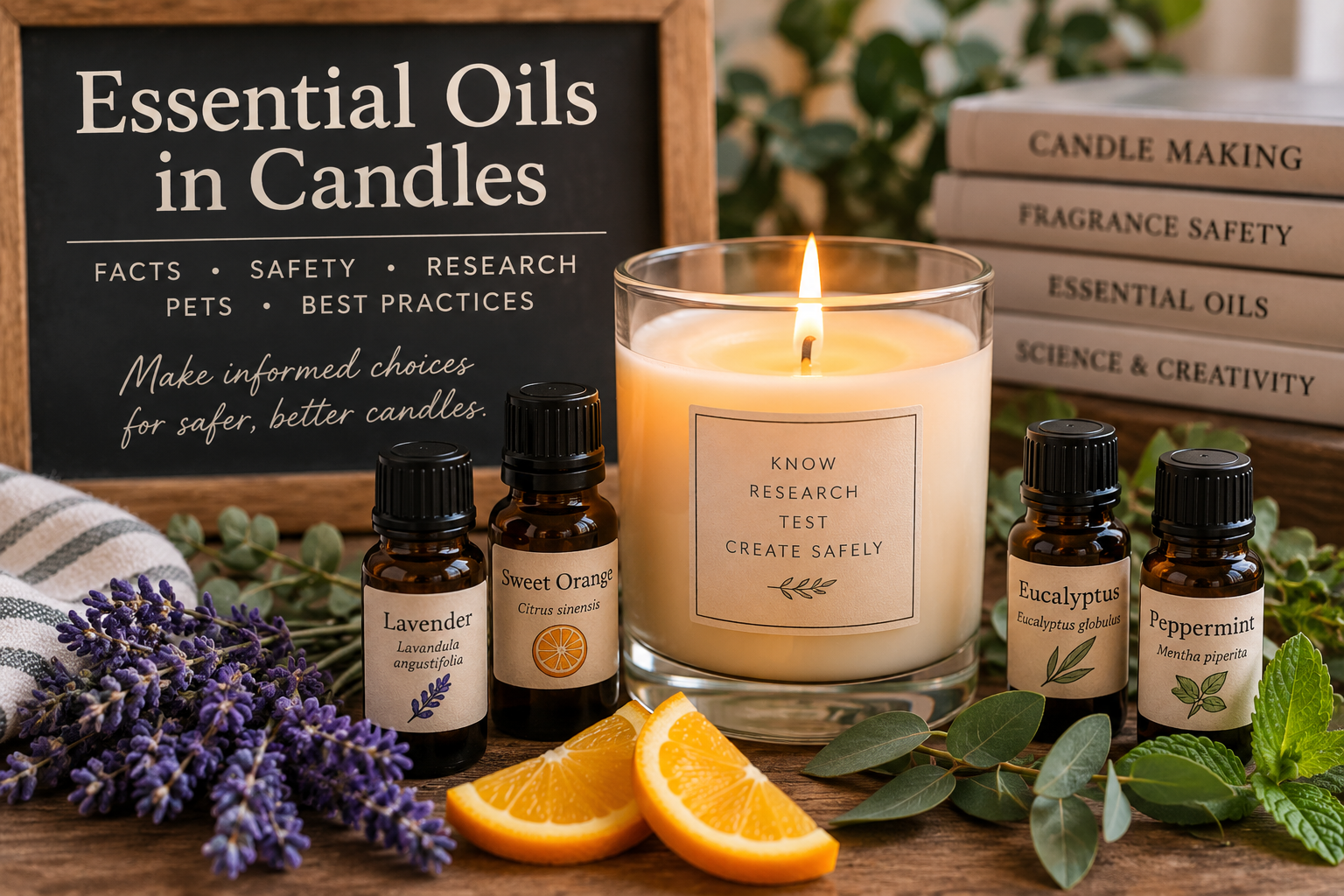
Essential Oils in Candles: Are They Really Toxic? What the Science Actually Says
Spend enough time in candle-making groups and you will eventually hear a statement like this:
“You should never use essential oils in candles because essential oils become toxic when they are burned.”
It sounds convincing. Essential oils are highly concentrated plant materials, candles involve an open flame, and everyone wants to make a safe product.
But is the statement actually supported by science?
After reviewing information from the International Fragrance Association (IFRA), U.S. Environmental Protection Agency (EPA), U.S. Food and Drug Administration (FDA), Poison Control, Merck Veterinary Manual, ASPCA, published toxicology research, and scientific studies measuring candle emissions, the answer is much more complicated.
Essential oils are not automatically safe because they are natural—but they are not automatically toxic simply because they are used in a candle either.
The truth depends on the specific essential oil, its chemical composition, how much is used, how a person or animal is exposed, and how the finished candle burns.
First, “Hazardous” and “Dangerous to Use” Are Not the Same Thing
One of the biggest sources of confusion comes from looking at the Safety Data Sheet for an essential oil.
A bottle of essential oil may carry warnings such as harmful if swallowed, skin sensitizer, eye irritant, toxic to aquatic life, or flammable.
Those warnings are important, but they normally describe the concentrated raw material.
They do not automatically tell us what risk exists when a much smaller amount of that material is incorporated into a finished consumer product.
Modern toxicology evaluates not only whether a substance *can* cause harm, but also the amount, route and duration of exposure. The National Institute of Environmental Health Sciences explains that dose-response, exposure pathway and individual susceptibility are fundamental parts of determining toxicological risk.
Someone swallowing concentrated wintergreen essential oil is experiencing an entirely different exposure from someone smelling a properly formulated candle containing a small percentage of an approved fragrance material.
That distinction is extremely important.
It does not mean that dilution magically makes every chemical safe. It means risk has to be evaluated based on actual exposure rather than simply whether the raw ingredient possesses a hazard.
IFRA Actually Has a Category for Candles
Perhaps one of the strongest pieces of evidence against the claim that essential oils are universally unsuitable for candles comes from the International Fragrance Association.
IFRA maintains a science-based system for restricting, limiting or prohibiting fragrance materials based on toxicological evaluation.
Under IFRA's system, candles of all types are classified as Category 12 products.
Essential oils are considered Natural Complex Substances. Because an essential oil can contain dozens or even hundreds of naturally occurring chemicals, IFRA explains that manufacturers need to determine whether the oil contains constituents that are subject to an IFRA restriction.
The maximum allowable amount of the essential oil can then be calculated from the restricted constituents it contains.
That is very different from saying:
“Essential oils cannot be used in candles.”
Instead, the system essentially says:
Know what is in the essential oil and make sure the concentration of any restricted constituents remains within the acceptable level for the finished product.
There is another important point for candle makers.
IFRA explains that an official IFRA Certificate of Conformity generally applies to a formulated fragrance mixture—not an individual raw material such as an essential oil. For natural raw materials, the supplier should instead provide appropriate information concerning restricted constituents and conformity with applicable IFRA standards.
As of September 10, 2026, the 51st Amendment remains the currently implemented IFRA framework. The proposed 52nd Amendment has completed consultation, but IFRA says final notification is expected in January 2027.
That means candle makers should always check the current standards rather than relying on a chart or recommendation that may be several years old.
“Natural” Does Not Mean Safer
This is another area where both sides of the essential-oil debate sometimes go too far.
People who favor essential oils may assume that because something came from a plant, it must be safer than a synthetic fragrance chemical.
That is not scientifically justified.
The FDA specifically warns that an ingredient being “natural” or derived from a plant does not mean that it is safe. Plants naturally manufacture chemicals capable of irritating skin, causing allergic reactions or producing systemic toxicity.
The reverse assumption is also incorrect.
A synthetic fragrance molecule is not automatically more dangerous simply because it was manufactured rather than extracted from a plant.
What matters is the molecule, its toxicological properties and the amount of exposure.
In other words:
Natural versus synthetic is not a reliable way to determine fragrance safety.
What Happens When a Candle Burns?
Another common argument is that essential oils become toxic simply because they are exposed to a flame.
This statement also needs qualification.
A candle does not normally burn fragrance directly like gasoline being poured into a fire.
Wax melts around the wick. Liquid wax travels up the wick through capillary action and vaporizes near the flame. Fragrance also evaporates from the warm melt pool, which is an important part of how a scented candle produces hot throw.
Some fragrance components reach the high-temperature flame region and may participate in combustion or thermal decomposition.
But this is not unique to essential oils.
Every burning candle produces combustion products.
The EPA states that burning or combusting almost anything can produce particulate matter and that candles are one indoor source of particulate pollution. EPA therefore recommends adequate ventilation when candles are burned indoors.
That applies to unscented candles as well as scented candles.
What Have Scientists Actually Found in Candle Emissions?
A major 2021 study published in *Environment International* examined candles made using four different waxes and five fragrances, along with unscented controls.
Researchers measured carbon monoxide, nitrogen oxides, formaldehyde, benzene, polycyclic aromatic hydrocarbons, PM2.5, ultrafine particles and numerous organic compounds.
The researchers did detect combustion products and evaporated fragrance components.
However, when realistic indoor exposure scenarios were calculated, most predicted concentrations were well below established indoor guidance or reference values.
The researchers did identify exceptions under some conditions involving substances such as nitrogen dioxide, acrolein and benzo[a]pyrene.
That distinction matters.
The study did not show that scented candles produce “nothing harmful.”
But it also did not support the idea that simply detecting a chemical in candle emissions proves that normal candle use is toxic.
Detection and dangerous exposure are not the same thing.
A Study Specifically Using Lavender Essential Oil
An especially interesting study published in 2026 examined a paraffin candle containing 6% lavender essential oil.
Researchers measured polycyclic aromatic hydrocarbon emissions while changing room ventilation and humidity.
PAHs were measurable.
Ventilation significantly influenced the resulting exposure.
For the study's highest modeled occupational scenario—someone exposed eight hours per day over a 40-year working lifetime—the highest calculated incremental lifetime lung-cancer risk was approximately 1.2 in one million.
This study should not be interpreted as proving that all lavender candles are safe. It involved one wax, one fragrance system, one concentration and specific laboratory conditions.
But it does demonstrate something important:
Scientists are capable of measuring emissions from an essential-oil candle and evaluating the resulting exposure, rather than simply declaring that the presence of an essential oil makes the candle toxic.
It also reinforces the importance of ventilation.
What About Limonene, Linalool and Other Terpenes?
Many essential oils contain large amounts of terpenes.
Citrus oils commonly contain limonene. Lavender contains substantial amounts of linalool and linalyl acetate. Pine-related fragrances can contain alpha-pinene and beta-pinene.
These compounds deserve attention.
Limonene can react with ozone in indoor air and form secondary organic particles and oxidation products. Laboratory studies have demonstrated the formation of secondary particles when ozone reacts with limonene under indoor conditions.
Limonene and linalool can also oxidize during storage. Their oxidation products are established contact allergens in susceptible individuals.
This does not mean that every candle containing lavender or citrus essential oil is dangerous.
It means that natural fragrance materials contain real chemicals with real chemistry, and they should be treated with the same respect given to synthetic fragrance ingredients.
Flash Point Is Frequently Misunderstood
Candle makers frequently look at the flash point of an essential oil and assume that a low flash point means the oil cannot safely be used in a candle.
That isn't what flash point means.
OSHA defines flash point as the minimum temperature at which a liquid produces enough vapor to create an ignitable mixture with air under a specified test method.
It is primarily a flammability and handling measurement.
Flash point does not tell us whether a substance is toxic.
It also does not establish the proper fragrance load for a candle.
Flash point can certainly be relevant when storing, shipping and handling fragrance materials, but it should not be used as a substitute for an IFRA assessment or finished-candle burn testing.
Are There Essential Oils That Should Not Be Used?
Absolutely.
This is where the claim that “essential oils are always safe because they're natural” becomes equally misleading.
Some natural fragrance materials have significant toxicological problems.
Costus Root Oil
IFRA prohibits costus root oil, absolute and concrete from use as fragrance ingredients.
The restriction is associated with its strong sensitization potential.
For a candle maker following modern fragrance-safety standards, this is not an oil that should simply be added to a candle because it is available from an essential-oil supplier.
Chenopodium or American Wormseed Oil
IFRA also lists Chenopodium oil, sometimes called American wormseed oil, as a prohibited fragrance ingredient.
This demonstrates why choosing oils solely because they are sold as “100% pure essential oil” is not adequate safety screening.
Crude Cade Oil
Cade oil provides another good example.
IFRA states that crude cade oil should not be used as a fragrance ingredient because the material produced through pyrolysis can contain problematic polycyclic aromatic hydrocarbons.
Properly rectified cade oil may be used only when it meets strict specifications limiting PAH contamination.
In other words, even two products carrying essentially the same plant name may have completely different safety profiles depending on how they were processed.
Sassafras and Safrole-Containing Oils
Safrole is naturally present in sassafras oil and can also occur in certain other natural materials.
IFRA restricts safrole, isosafrole and dihydrosafrole so that their combined concentration from natural sources does not exceed 0.01% of the finished consumer product.
This is a perfect example of why the percentage of the essential oil itself isn't always the number that matters.
You sometimes have to know the concentration of a particular constituent within the oil.
Pennyroyal Oil
Pennyroyal deserves special caution.
Published human poisoning cases show that ingestion of concentrated pennyroyal oil can cause severe liver injury, neurological injury, multiple-organ failure and death. Pulegone and its metabolites are believed to be responsible for much of this toxicity.
This evidence concerns concentrated ingestion rather than normal candle exposure, so it would be scientifically incorrect to claim that a pennyroyal candle produces the same exposure.
But given the known toxicity of the raw oil, it is a material that should never be casually formulated into a candle without professional safety evaluation and current regulatory/IFRA review.
Wintergreen and Sweet Birch
Wintergreen oil consists largely of methyl salicylate, a chemical related to aspirin.
Concentrated wintergreen oil can produce severe salicylate poisoning if swallowed. Poison Control notes that even relatively small amounts can present a serious poisoning hazard, particularly to children.
Again, this does not prove that a properly formulated wintergreen-scented candle causes salicylate poisoning through normal inhalation.
It does mean concentrated wintergreen oil deserves considerably more respect than the phrase “natural essential oil” might suggest.
Essential Oils and Pets: This Requires a Separate Discussion
Pet safety is one of the most misunderstood portions of this subject.
Dogs and cats can absolutely be poisoned by concentrated essential oils.
Veterinary toxicology sources document poisoning from ingestion, skin exposure and inhalation of highly concentrated or aerosolized oils.
Cats are particularly susceptible to certain essential-oil components because of differences in liver metabolism.
However, a burning candle is not the same type of exposure as putting essential oil on an animal, allowing an animal to lick it, or using an ultrasonic diffuser that produces airborne liquid droplets.
The peer-reviewed Merck Veterinary Manual specifically identifies candles and reed diffusers as passive diffusers.
According to Merck, passive diffusers do not release actual oil droplets. Unless the oil is spilled, eaten or otherwise contacts the animal, the primary concern is respiratory irritation.
That is an extremely important distinction.
It means statements such as “one drop of tea tree oil can poison a cat, therefore a candle containing tea tree oil will poison a cat” are not scientifically equivalent exposure scenarios.
At the same time, that does not mean every essential-oil candle should be advertised as pet-safe.
Essential Oils of Particular Concern Around Cats and Dogs
Veterinary sources identify several oils involved in poisoning incidents.
For cats, reported problem oils include wintergreen, sweet birch, citrus oils, pine oils, ylang ylang, peppermint, cinnamon, pennyroyal, clove, eucalyptus and tea tree oil.
Dogs can also be affected by wintergreen, sweet birch, pine, cinnamon, pennyroyal, eucalyptus and tea tree oils, among others.
The most serious exposures generally involve concentrated oil being swallowed, placed on the skin or fur, spilled, or dispersed in a manner that produces airborne droplets.
Pets with asthma, chronic bronchitis or other respiratory disease deserve additional caution around any strong fragrance.
Birds Are Different
Birds deserve their own warning.
Veterinary authorities consistently describe birds as particularly sensitive to airborne contaminants because of their highly efficient and specialized respiratory systems.
Merck Veterinary Manual states that birds are at high risk from fragrances and aerosolized particles.
ASPCA similarly advises avoiding essential-oil diffusers in homes with birds.
Since candles also produce combustion particles regardless of whether the fragrance is natural or synthetic, the prudent recommendation for bird owners is to avoid burning strongly scented candles in the same airspace as the bird.
Calling an essential-oil candle—or any scented candle—universally “bird safe” would not be supported by the evidence I found.
So Are Essential Oils Safe in Candles?
The most scientifically defensible answer is:
Some essential oils can be appropriate fragrance ingredients for candles when they have been properly identified, evaluated, formulated and tested.
But that answer comes with conditions.
A candle maker should know the botanical identity of the oil, obtain an SDS and technical documentation, determine whether the oil contains IFRA-restricted constituents, calculate the allowable concentration for Category 12, and perform complete burn testing on the finished candle.
The candle still has to function safely.
A fragrance that complies with a toxicological standard could still cause a candle to burn poorly, soot excessively, produce an unstable flame, clog a wick, overheat a container or otherwise fail a candle safety test.
Chemical safety and candle performance testing are two different requirements.
U.S. Consumer Product Safety Commission guidance points candle manufacturers toward ASTM standards addressing candle fire safety, visible emissions, containers and safety labeling.
Why “100% Essential Oil” Is Not Enough Information
Essential oils are agricultural products.
Their chemistry can change according to species, chemotype, geographical location, growing conditions, harvest time, extraction method, storage and oxidation.
Buying a bottle labeled simply “Cinnamon Essential Oil” does not necessarily tell a candle maker enough.
Cinnamon bark oil and cinnamon leaf oil, for example, can have dramatically different chemical compositions.
The same problem exists with eucalyptus species, cedar oils, citrus oils and many other botanicals.
Professional formulation should therefore be based on technical documentation for the actual material—not just the common plant name.
What About Fragrance Oils?
Fragrance oil should not automatically be treated as either safer or more dangerous.
A professionally formulated candle fragrance may contain synthetic aroma chemicals, natural isolates, essential oils or combinations of all three.
One advantage of a professionally formulated candle fragrance is that the fragrance house can formulate around known restrictions and provide an IFRA Certificate of Conformity for the fragrance mixture.
That does not make every fragrance oil perfectly harmless.
It means there is usually a clearer safety-assessment pathway for that particular finished fragrance mixture.
Essential oils can be evaluated as well, but because they are complex natural raw materials, the candle maker may need considerably more information about their composition.
A Note About “Non-Toxic Candle” Claims
No burning candle literally produces nothing except fragrance.
Combustion creates particles and chemical byproducts.
For that reason, claims such as “completely toxin-free,” “chemical-free” or “produces no harmful emissions” are scientifically difficult to defend.
That applies to essential-oil candles, fragrance-oil candles, soy candles, beeswax candles and paraffin candles.
A much more accurate approach is to say that a product has been formulated using fragrance materials evaluated for their intended candle application and has been properly burn tested.
Safety is not the absence of chemistry.
Safety is managing the chemistry and the exposure.
The Bottom Line
The claim that “essential oils should never be used in candles because burning essential oils makes them toxic” is not supported as a universal scientific rule.
There is legitimate evidence showing that essential oils can contain hazardous chemicals. Some natural fragrance materials are restricted, some are prohibited, and several concentrated essential oils can cause serious poisoning if swallowed or applied incorrectly.
There is also legitimate evidence showing that essential oils are recognized fragrance raw materials that can be evaluated for candle applications through established fragrance-safety systems.
Both facts can be true at the same time.
The correct question isn't:
“Are essential oils toxic?”
The better questions are:
Which essential oil? What is actually in it? At what concentration? In what finished product? By what exposure route? What does the current safety assessment say? And how does the finished candle perform when it is burned?
That is where science replaces fear, assumptions and marketing claims.
And that is probably the most important lesson for candle makers:
Natural does not automatically mean safe. Synthetic does not automatically mean dangerous. And finding that a substance can be hazardous does not automatically mean that every properly formulated product containing it presents a dangerous exposure.
The formulation, dose, exposure and finished-product testing matter.
---
Research Notes and Sources
Research checked through September 10, 2026.
- National Institute of Environmental Health Sciences — “Toxicology.” NIEHS explains the importance of dose-response, exposure route and individual susceptibility when evaluating toxicological risk.
- U.S. Food and Drug Administration — “Aromatherapy.” FDA specifically states that plant-derived or “natural” essential oils are not automatically safe and notes that plants can contain toxic, irritating or allergenic substances. FDA also explains that scented candles generally fall under Consumer Product Safety Commission jurisdiction rather than cosmetic regulation.
- International Fragrance Association — IFRA Standards and 51st Amendment Guidance. IFRA classifies candles of all types as Category 12 and provides a process for determining acceptable concentrations of Natural Complex Substances such as essential oils based on their restricted constituents.
- IFRA — Using and Understanding the Standards. IFRA states that official Certificates of Conformity generally apply to fragrance mixtures rather than individual raw materials. Essential-oil suppliers should communicate information concerning restricted constituents and applicable standards.
- IFRA — 52nd Amendment update, August 31, 2026. The 52nd Amendment had completed consultation but had not yet received final notification as of this article's research date. IFRA said final notification was expected in January 2027.
- U.S. Environmental Protection Agency — “Sources of Indoor Particulate Matter.” EPA identifies candles as indoor combustion sources capable of producing particulate matter and other combustion byproducts and recommends adequate ventilation.
- Salthammer T. et al., Environment International, 2021 — “Measurement and evaluation of gaseous and particulate emissions from burning scented and unscented candles.” Researchers tested multiple waxes and fragrances and found that calculated indoor concentrations were generally below relevant guidance/reference values, while identifying exceptions under some conditions for compounds including nitrogen dioxide, acrolein and benzo[a]pyrene. PMID 33964641.
- 2026 candle study — “Emissions of Polycyclic Aromatic Hydrocarbons (PAHs) from the Use of Scented Candles Under Different Environmental Conditions.” The tested candle consisted of paraffin wax plus 6% lavender essential oil. The research demonstrated measurable PAH emissions, a substantial influence of ventilation conditions and a highest modeled incremental lifetime lung-cancer risk of approximately 1.2 × 10^-6 for the study's long-term occupational exposure scenario.
- Indoor-air studies of limonene and ozone. Research demonstrates that limonene can react with indoor ozone to produce secondary organic particles and oxidation products. These findings apply to terpene chemistry generally and are not evidence that every citrus-scented candle creates a dangerous exposure.
- Published dermatology research on limonene and linalool oxidation. Air-oxidized limonene and linalool can form hydroperoxides capable of producing allergic contact reactions in susceptible individuals.
- Occupational Safety and Health Administration — flash-point definition. OSHA defines flash point based on formation of an ignitable vapor-air mixture. It is a physical flammability property and should not be confused with a toxicological exposure limit or allowable candle fragrance percentage.
- IFRA Standards — prohibited and restricted natural materials. IFRA prohibits costus root oil as a fragrance ingredient. Chenopodium/American wormseed oil is also prohibited. Crude cade oil is prohibited, while appropriately rectified cade oil must meet PAH specifications. Safrole-containing natural materials are subject to a maximum combined safrole/isosafrole/dihydrosafrole concentration of 0.01% in the finished product.
- Pennyroyal toxicology. Published human cases document severe hepatic and neurological toxicity and death following concentrated pennyroyal ingestion. These poisoning cases do not represent candle inhalation exposure but establish that the raw material has significant intrinsic toxicity.
- Wintergreen/methyl salicylate toxicology. Poison Control and medical literature document severe poisoning potential from ingestion of concentrated wintergreen oil. Again, this is a different exposure route from normal candle use but demonstrates why concentrated natural materials require careful handling.
- Merck Veterinary Manual — “Toxicoses From Essential Oils in Animals,” reviewed 2025. Merck explains that cats have increased susceptibility to certain essential oils, birds are particularly sensitive to fragrances and airborne particles, and passive diffusers such as candles do not release actual droplets of essential oil. For passive diffusion, absent spilling or ingestion, the principal animal concern is respiratory irritation.
- ASPCA Animal Poison Control Center and Pet Poison Helpline. These veterinary poison-control sources document essential-oil toxicity from concentrated exposures and identify oils associated with poisoning in cats and dogs. Pet Poison Helpline also specifically distinguishes passive devices such as candles from active diffusers that aerosolize oil droplets.
- U.S. Consumer Product Safety Commission — Candle Business Guidance. CPSC provides guidance on candle safety and references ASTM standards covering fire safety, candle containers, visible emissions and safety labeling.
Research limitation: There is considerably more published research on scented candles in general, concentrated essential-oil poisoning, essential-oil diffusers and individual fragrance chemicals than there is on every individual essential oil burned in every possible candle formulation. Therefore, claims that *all* essential oils are safe in candles would be unsupported—just as claims that *all* essential oils become toxic when burned are unsupported.