
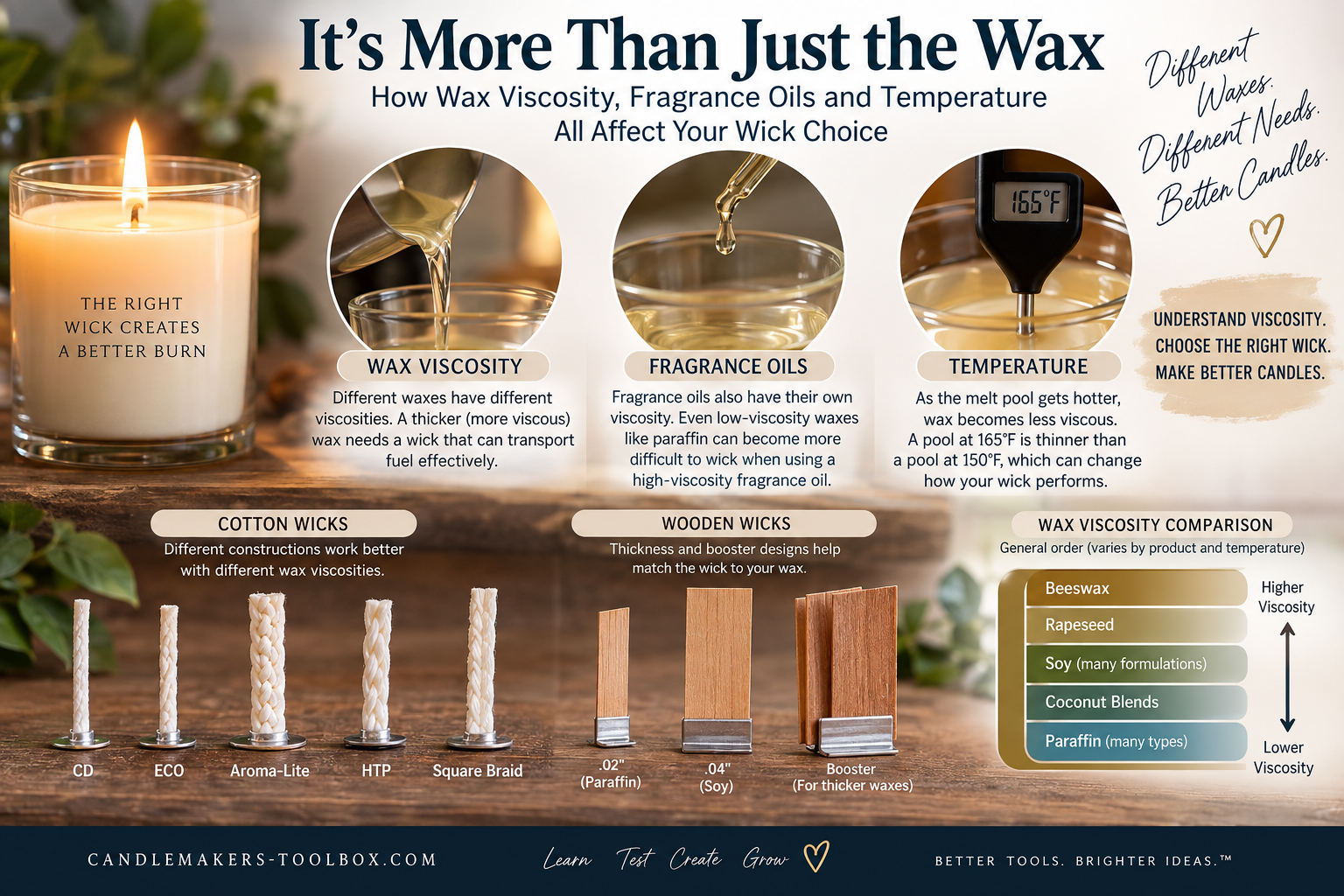
When candle makers choose a wick, one of the first questions is usually:
“What kind of wax are you using?”
That is an important question—but it is not the whole story.
A paraffin candle, a soy candle and a beeswax candle can require very different wick constructions because their molten waxes behave differently. But even two candles made with the exact same wax may require different wicks when different fragrance oils are added.
Why?
One of the factors involved is viscosity.
And viscosity doesn't stay constant while a candle burns.
Wax type affects viscosity. Fragrance oil can affect the finished fuel mixture. Additives can affect it. And perhaps most importantly, temperature affects it.
That means your wick isn't simply burning “soy wax” or “paraffin wax.”
It is transporting and burning a constantly changing liquid mixture of wax, fragrance oil and other additives at temperatures that change throughout the burn.
Understanding this can explain a lot of candle behavior that otherwise seems confusing.
---
First: What Is Viscosity?
Viscosity simply describes how resistant a liquid is to flowing.
Think about the difference between water and honey.
Water has low viscosity. It pours easily and moves quickly.
Honey has much higher viscosity. It moves more slowly and requires more effort to flow.
Molten candle wax behaves the same way.
Some molten waxes flow relatively easily. Others are thicker and more resistant to movement.
This matters because a candle wick must continuously transport liquid fuel from the melt pool upward toward the flame.
A wick does this largely through capillary action.
If you have ever touched the corner of a paper towel to spilled water and watched the water travel upward through the towel, you have seen capillary action.
A candle wick works on the same basic principle.
Liquid wax moves through tiny spaces within the wick toward the flame. Scientific models of capillary flow show that viscosity is one of the properties controlling how quickly a liquid travels through a porous material: as viscosity increases, resistance to flow increases.
So the wick isn't simply something that burns.
The wick is the candle's fuel-delivery system.
---
Wax Type Matters—But Wax Names Can Be Misleading
It is common to hear statements such as:
“Paraffin is thin.”
“Soy is thick.”
“Beeswax needs a bigger wick.”
Those statements may be useful as general starting points, but they are not universal rules.
Commercial candle waxes are formulations. Two products both labeled “paraffin” may have very different physical properties. The same applies to soy, coconut and other waxes.
For example, look at these representative viscosity specifications measured at the same general laboratory temperature of 100°C/212°F:
| Representative candle wax | Approximate viscosity at 100°C |
| -------------------------------------------------- | -----------------------------: |
| Beeswax | 8–12 cSt |
| Rapeseed container wax | about 10 cSt |
| KeraSoy Container | about 9.7 cSt |
| Coconut candle wax blend | about 8.6 cSt |
| KeraSoy Pillar | about 8.4 cSt |
| IGI Parafflex 4630A container paraffin formulation | about 7.0 cSt |
| British Wax paraffin container wax | about 4–5 cSt |
This is not meant to be a universal ranking of every soy, paraffin, coconut or beeswax product.
In fact, the table demonstrates exactly why universal rankings can be misleading.
Notice that even two paraffin-based container waxes can be substantially different.
Also remember that 212°F is much hotter than a normal candle melt pool. Manufacturers commonly report viscosity at 100°C because using the same standardized temperature makes products easier to compare.
The important lesson is the trend:
Some refined paraffins can be relatively low-viscosity liquids, while many vegetable waxes and beeswax formulations are more viscous. But the actual formulation matters more than the name printed on the box.
---
Then We Add Fragrance Oil
This is where candle wicking becomes much more interesting.
Suppose you have a relatively low-viscosity paraffin wax.
You might assume that wax will always need a wick suited to an easy-to-burn, low-viscosity fuel.
But now add 7%, 8%, 10% or more fragrance oil.
Fragrance oils are not all physically alike.
They are complicated mixtures of different aromatic materials, solvents and other ingredients. One fragrance may be extremely fluid while another is noticeably thicker.
CandleScience, for example, specifically uses fragrance oils with differing viscosities and compositions when performing wax burn testing because the differences can reveal changes in solubility and burn performance.
It also advises candle makers that a heavily fragranced or difficult formulation may require a different wick than the same wax with less fragrance or a thinner fragrance.
So you are not really wicking the wax anymore.
You are wicking the entire candle formulation.
That distinction is extremely important.
A paraffin candle containing a difficult, high-viscosity fragrance mixture may behave more like a difficult-to-wick system than you would predict by looking at the paraffin alone.
Likewise, a particular fragrance could make one wick perform beautifully while another fragrance at the same percentage produces a smaller flame, incomplete melt pool or repeated wick drowning.
That does not necessarily mean the wax changed.
The fuel mixture changed.
---
But Don't Blame Everything on Fragrance Viscosity
There is another important point.
A fragrance oil that looks thick at room temperature is not automatically going to remain proportionally thick at candle operating temperatures.
Viscosity itself changes with temperature.
And fragrance oils contain different chemical components that also affect combustion, carbon formation, solubility and how the fragrance interacts with the wick.
So fragrance viscosity is one factor, not the only factor.
This is why two fragrance oils that appear equally thick can still burn very differently.
It is also why candle testing remains necessary.
---
Melt Pool Temperature Changes Everything
Now we get to one of the most overlooked pieces of candle wicking:
The temperature of the melt pool changes its viscosity.
As most liquids become hotter, their viscosity decreases.
In simple terms:
Hotter liquid wax becomes thinner and flows more easily.
This means a melt pool at 165°F will generally transport through a wick more easily than the same wax at 150°F.
We can see this directly in measured paraffin data.
Anton Paar's viscosity measurements for a paraffin wax show kinematic viscosity of roughly 7.8 cSt around 150°F and roughly 6.5 cSt around 165°F.
That represents approximately a 16% reduction in viscosity from only about a 15°F temperature increase in that particular wax sample.
That is a meaningful difference.
And it creates an interesting relationship between the wick and the wax.
The wick controls flame size.
Flame size affects heat.
Heat affects melt-pool temperature.
Melt-pool temperature affects viscosity.
Viscosity affects how easily fuel travels through the wick.
And that fuel supply affects the flame again.
The system is constantly interacting with itself.
---
This Helps Explain Why Candle Behavior Changes During a Burn
Imagine two wicks in the same wax.
Wick A produces a smaller flame and maintains a melt-pool temperature around 150°F.
Wick B produces a somewhat larger flame and maintains a melt-pool temperature around 165°F.
Wick B is not only producing more heat.
It is now working with less-viscous fuel.
The warmer wax may move through the wick more easily, potentially supplying the flame more effectively.
This helps explain why wick performance isn't always linear.
A wick can sometimes appear weak early in a burn but become considerably stronger as the candle, melt pool and container accumulate heat.
It also helps explain why testing only the first hour or first burn cycle can be misleading.
As the candle burns farther down into a container, heat retention can increase. The melt pool may become hotter. The wax becomes less viscous. Fuel delivery can change, and the candle that looked perfect near the top of the jar may become considerably more aggressive later.
That is one reason full-life burn testing is so important.
---
Wick Construction Matters as Much as Wick Size
Another common mistake is treating wick selection as if every wick series is simply a different set of sizes.
It isn't.
Wick construction changes the way fuel is transported and burned.
Fiber type, braid construction, number of fiber bundles, core material, chemical treatment, wick stiffness and wick curvature can all influence fuel capacity and combustion behavior. Atkins & Pearce specifically notes that fiber arrangement, braid construction and size contribute to a wick's fuel capacity.
This means changing from one wick series to another can sometimes solve a problem more effectively than simply choosing a larger wick in the same series.
---
Aroma-Lite and High-Fragrance Candles
Aroma-Lite is a particularly interesting example.
Aroma-Lite wicks are manufactured by Atkins & Pearce and were specifically engineered for candle systems containing high levels of fragrance and other difficult-to-burn container and pillar formulations.
That makes Aroma-Lite worth testing when adding a particular fragrance causes a candle that normally burns well to become sluggish.
It would not be technically accurate to say the manufacturer specifically markets Aroma-Lite as a “high-viscosity wick.”
Instead, it is designed for high-fragrance and tough-to-burn systems.
That distinction matters.
If your candle becomes difficult to wick after adding fragrance, Aroma-Lite may work extremely well—not necessarily because the fragrance is viscous alone, but because the entire fragranced fuel system has become more difficult to burn.
---
For Truly High-Viscosity Wax, Look at Square Braid
Interestingly, Atkins & Pearce does identify another wick construction specifically for high viscosity.
Its Bleached Square Wick was originally developed for beeswax and is described by the manufacturer as an excellent choice for waxes that are highly viscous when molten, including beeswax and vegetable waxes.
That is a very useful distinction.
If the main challenge appears to be a genuinely viscous molten wax, square braid may deserve consideration.
If the main challenge appears after adding a high fragrance load, Aroma-Lite may deserve consideration.
And sometimes the formulation presents both challenges.
---
HTP and Other Difficult Formulations
HTP is another useful series to understand.
Atkins & Pearce describes HTP as being particularly suited to difficult-to-burn formulations containing additives and suitable for paraffin, vegetable and gel candle systems.
The company's Helix wick takes the concept even further. Helix is made by braiding two Aroma-Lite wicks together and was developed for difficult, high-fragrance formulations—particularly vegetable wax systems requiring a larger melt pool from a single wick.
The lesson isn't that one of these wick series is universally “best.”
The lesson is:
Wick construction should be matched to the fuel system.
---
Wooden Wicks and Viscosity
Wooden wicks make the relationship between wax properties and wick construction especially easy to see.
With wooden wicks, several variables can be changed independently.
There is the width of the wick.
There is the thickness of the wood.
And there is the construction—single-ply, dual-ply, booster, Ultimate and other designs.
Changing thickness changes the amount of wood available to support combustion. Makesy specifically notes that wooden wick thickness has a major influence on whether the wick will burn properly.
Their recommendations also show the same general pattern candle makers often discover through testing.
An easier-burning wax may work with thinner wood.
A more difficult vegetable-wax system may require thicker wood or a booster construction.
For example, Makesy notes that 100% soy frequently requires approximately a .04-inch flat wooden wick thickness, while an easier-burning coconut-apricot formulation may start around .02 inch.
Their X-wick recommendations show a similar progression: roughly .01 for paraffin, .02 for natural blends such as para-soy or soy-coconut, and .03 for 100% soy as starting points.
These are starting recommendations—not universal laws.
Fragrance, fragrance percentage, container diameter, wick width, dye and the exact wax formulation can all move the correct wick in either direction.
---
What Does a Booster Do?
A booster wooden wick adds another strip of wood to the main wick.
That gives the wick additional material and changes its burning characteristics.
Booster-style wooden wicks were specifically developed to improve performance in natural waxes, and patent literature describing the design notes that the added booster helps the wooden wick burn more effectively in vegetable-based wax systems.
Makesy similarly recommends single-ply wooden wicks primarily for easier-to-burn blends, while booster and Ultimate constructions are used across more demanding wax systems including soy and other vegetable waxes.
That makes boosters particularly interesting when dealing with a fuel system that a single piece of wood struggles to sustain.
Again, though, more wood is not automatically better.
A booster that solves a drowning problem near the beginning of the candle could become excessively hot later in the burn.
The entire candle must be tested.
---
Don't Confuse Viscosity, Density and Melt Point
These three properties are often mixed together, but they are not the same thing.
Viscosity describes resistance to flow.
Density describes how much mass exists in a given volume.
Melting point describes the temperature range where the solid wax becomes liquid.
A wax can have a relatively low melting point but still have substantial viscosity once molten.
Likewise, a fragrance can be dense without necessarily being extremely viscous.
Flash point is yet another property and should not be used as an indicator of viscosity or wick requirement.
When diagnosing wick performance, keeping these properties separate makes troubleshooting much easier.
---
Should You Automatically Wick Up When the Candle Struggles?
No.
A weak flame or incomplete melt pool does not automatically mean “use a bigger wick.”
First determine why the existing wick is struggling.
If the wick cannot transport enough fuel and repeatedly begins to drown, additional wick capacity or a wick construction better suited to the formulation may help.
But sometimes switching wick series is a better solution than simply increasing size.
A larger wick may create a hotter melt pool, which lowers viscosity and increases fuel flow even further. That feedback can transform an apparently small wick adjustment into a candle that becomes too hot later in its life.
That is why flame height, melt-pool temperature, rate of wax consumption, carbon buildup, soot and container temperature should all be evaluated together.
The goal isn't simply to create a full melt pool.
The goal is to create a stable and safe fuel-delivery system from the first burn through the final burn.
---
A Better Way to Test Fragrances
If you want to understand what a particular fragrance is doing to your candle, compare it against a baseline.
Make an unscented candle using your normal wax, container and wick.
Then make another using the same wax, container and wick but add your fragrance.
Keep everything else the same.
If possible, test several fragrances at the same fragrance percentage.
Record flame height, melt-pool diameter, melt-pool depth, melt-pool temperature, rate of consumption, wick carbon buildup and container temperature.
You may discover that the wick performs beautifully with one fragrance and struggles with another.
That is valuable information.
Instead of concluding that your wax “needs an LX 18” or “needs an Aroma-Lite 140,” you begin thinking in terms of complete formulations:
This wax + this fragrance + this fragrance percentage + this container works with this wick.
That is a much more accurate approach to candle testing.
---
The Bigger Lesson: A Candle Is a System
Wick charts are valuable.
Wax recommendations are valuable.
Manufacturer testing is valuable.
But none of them can account for every possible combination of wax, fragrance, dye, fragrance percentage, container geometry and wick.
That is why wick charts should be treated as starting points rather than answers.
The wick doesn't know whether the label on the wax box says soy, paraffin, coconut or beeswax.
The wick interacts with the molten fuel that surrounds it.
Its job is to move that fuel toward the flame at a rate the flame can consume safely.
That fuel's viscosity changes with its formulation.
It changes when fragrance is added.
And it changes as its temperature changes during the burn.
Once you begin looking at wick selection this way, many candle-making problems start making a lot more sense.
You aren't simply choosing a wick for a wax.
You are choosing a wick for an entire fuel system.