
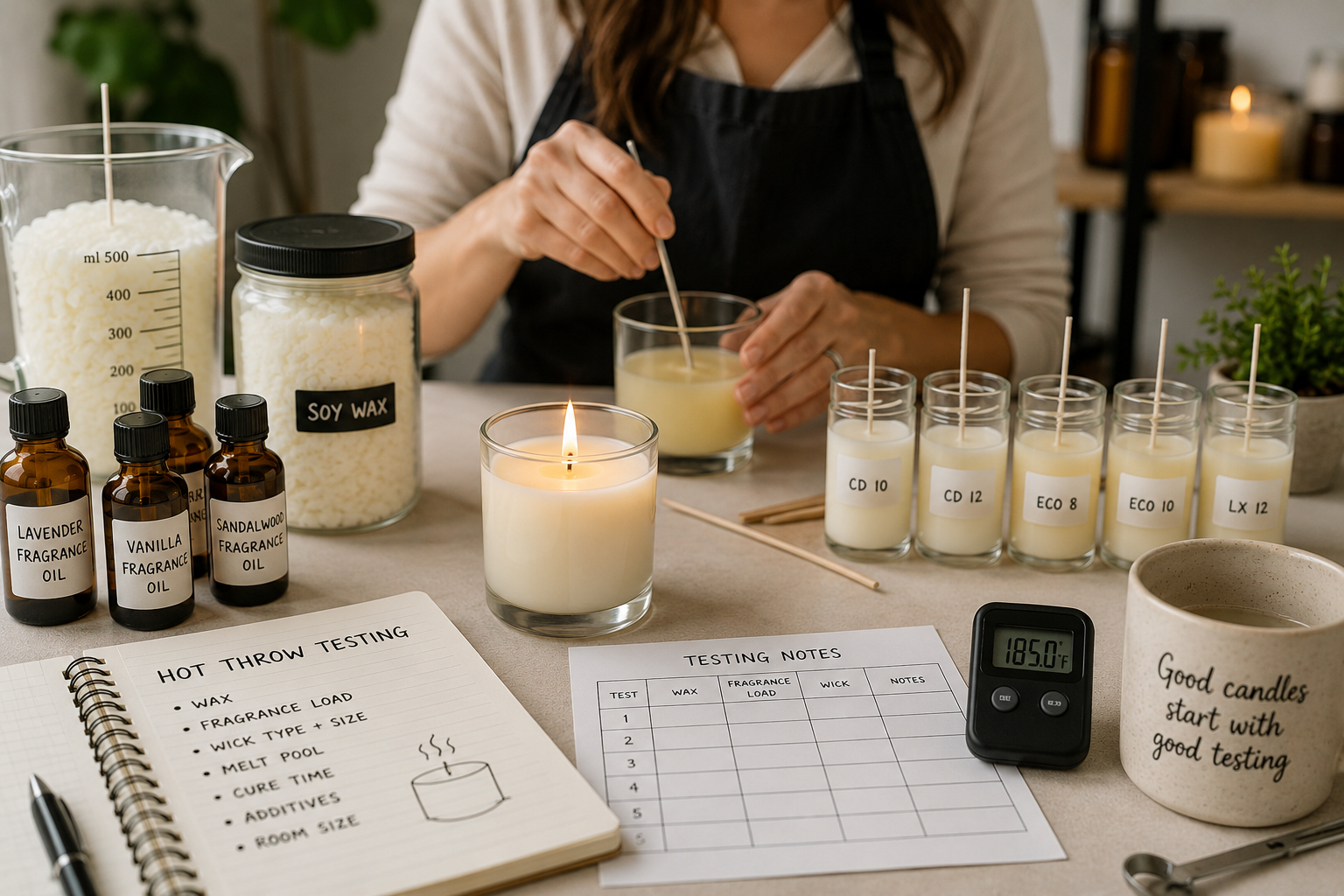
Weak hot throw is one of the most frustrating problems in candle making.
You can use a fragrance oil that smells amazing in the bottle. Your candle can smell strong when it is sitting on the table. The cold throw may seem perfect. But once the candle is lit, the scent disappears, feels weak, or barely fills the room.
When this happens, the first instinct is usually to add more fragrance oil.
But weak hot throw is not always a fragrance oil problem.
Most of the time, weak hot throw is a candle system problem. The wax, fragrance oil, wick family, wick size, jar, cure time, dye, mica, and other additives all work together. If one part of that system is off, the candle may not release fragrance properly while burning.
That is why fixing weak hot throw requires more than asking, “How much fragrance oil should I use?”
A better question is:
Is this wax, wick, fragrance oil, container, and additive combination burning correctly together?
What Is Hot Throw?
Hot throw is the scent a candle gives off while it is burning.
This is different from cold throw, which is the scent you smell when the candle is unlit. A candle can have a strong cold throw and still have a weak hot throw.
That happens because cold throw and hot throw depend on different things.
Cold throw comes from fragrance sitting in the wax and releasing scent from the surface of the candle. Hot throw depends on the candle actually burning well. The wick has to create enough heat, the wax has to melt properly, and the fragrance has to release from the melt pool into the air.
In simple terms:
Cold throw tells you how the candle smells sitting still. Hot throw tells you how well the candle performs while burning.
That performance depends heavily on wax choice and wick choice.
Which Waxes Usually Have the Best Hot Throw?
Not all candle waxes throw fragrance the same way.
In general, waxes that contain paraffin tend to have the strongest hot throw. This is one reason many strong-smelling commercial candles use paraffin or paraffin blends.
Here is the general pattern many candle makers notice:
- Paraffin wax: Usually very strong
- Paraffin/soy blends: Usually strong
- Coconut/paraffin blends: Usually strong
- Coconut apricot blends with paraffin: Often strong
- Coconut-soy blends: Moderate to strong
- 100% soy wax: Can be good, but more sensitive
- Beeswax and harder natural waxes: Often more difficult for strong fragrance throw
This does not mean soy wax cannot have good hot throw. It can. Many candle makers successfully make strong soy candles.
But soy wax usually requires more testing. It often needs the right fragrance oil, the right wick family, proper cure time, and a clean burn. Soy can be less forgiving than paraffin blends when something is slightly off.
Paraffin and paraffin-containing blends often make hot throw easier because they tend to release fragrance more readily. Paraffin/soy blends and coconut/paraffin blends are popular for this reason. They can give makers a balance between strong scent throw, smoother appearance, and easier burning.
Some examples of wax styles often chosen for stronger hot throw include:
- Paraffin container waxes
- Paraffin/soy blends
- Coconut/paraffin blends
- Coconut apricot blends that include paraffin
- Luxury blended container waxes designed for fragrance performance
Natural waxes such as soy, coconut-soy, and apricot-soy can still perform well, but they usually need more careful testing.
The key point is this:
If maximum hot throw is the main goal, paraffin and paraffin blends usually have an advantage. If a maker wants to use soy or another natural wax, strong hot throw is still possible, but the wax/wick/fragrance combination becomes even more important.
More Fragrance Oil Does Not Always Mean Stronger Hot Throw
This is one of the biggest misunderstandings in candle making.
When a candle smells weak, many beginners think:
“I need to add more fragrance oil.”
Sometimes a small increase may help. But many times, adding more fragrance oil can make the candle burn worse and actually reduce hot throw.
Every wax has a maximum fragrance load. But the maximum is not always the best amount to use. Just because a wax can hold 10% fragrance oil does not mean 10% will give the best hot throw.
In many formulas, 6%, 7%, or 8% may burn cleaner and throw better than the maximum fragrance load.
Too much fragrance oil can cause several problems.
First, the wax may not hold the oil properly. When the wax is overloaded, fragrance oil can separate, sweat, leach, or create oily spots. If the fragrance is not properly bonded throughout the wax, the candle may not burn evenly or release scent consistently.
Second, too much fragrance oil can interfere with the wick. A wick works by pulling melted wax up to the flame. If the melt pool is overloaded with fragrance oil, heavy fragrance components, dye, mica, or other additives, the wick may struggle to draw fuel correctly.
That can lead to:
- A weak flame
- Wick drowning
- Poor melt pool
- Mushrooming
- Smoking
- Soot
- Uneven burning
- Poor fragrance release
Third, a candle with too much fragrance oil may burn dirty. Smoke and soot can mask the fragrance. Instead of smelling the scent, the room may smell burnt, smoky, or heavy.
So the real goal is not to use the most fragrance oil possible.
The goal is to use the amount of fragrance oil that burns best in that wax, with that wick, in that container.
A strong candle is not just a heavily scented candle. A strong candle is a properly balanced candle.
Wick Family Matters, Not Just Wick Size
Wick choice is one of the most important parts of hot throw.
Many candle makers think wick selection is mostly about size. For example, they may think, “My jar is three inches wide, so I need this size wick.”
Container diameter matters, but it is only part of the decision.
The wick family or wick series matters too.
A CD wick, CDN wick, ECO wick, HTP wick, LX wick, Premier wick, Aroma Lite wick, and wooden wick do not all burn the same way. They are made differently. They curl differently. They pull wax differently. They create different flame shapes and different levels of heat.
This means two wicks with similar-looking numbers may perform completely differently.
For example, a CD 12 and an ECO 12 are not the same thing. A Premier wick number cannot be directly compared to an HTP wick number. Wick numbers usually only make sense inside the same wick series.
That is why changing from one wick family to another can completely change the candle’s performance.
The wick controls:
- Melt pool width
- Melt pool depth
- Flame temperature
- Wax consumption rate
- Fragrance release
- Soot level
- Mushrooming
- Whether the candle burns too hot or too cool
If the wick is too small, the candle may not create enough heat. The melt pool may be too small, and the fragrance may not release well.
If the wick is too large, the candle may burn too hot. It may smoke, soot, mushroom, burn too quickly, or make the fragrance smell harsh.
But sometimes the issue is not simply “wick up” or “wick down.”
Sometimes the issue is that the wax needs a different wick family.
That is why the starting point should be:
Match the wick family to the wax first, then test sizes inside that wick family.
This is the exact reason the Wax to Wicks flipbook was created for Candlemakers Toolbox. Instead of randomly guessing wick sizes, the guide helps candle makers start with wick families that are commonly better matches for the wax they already chose.
You can find the Wax to Wicks flipbook on the Flipbooks page at candlemakers-toolbox.com/flipbooks.
The important lesson is this:
Hot throw is not just about using a bigger wick. It is about using the right wick family for the wax, then choosing the correct size through testing.
The Melt Pool Is Where Hot Throw Happens
A candle does not throw scent just because fragrance oil is inside the jar.
The fragrance has to be released from the melted wax pool while the candle is burning.
If the candle never develops a proper melt pool, hot throw will usually be weak. This is why under-wicked candles often smell faint. They may have plenty of fragrance oil in the wax, but the candle is not producing enough heat to release it into the room.
A good melt pool helps warm the fragrance and carry it into the air.
But bigger is not always better. A melt pool that is too deep or too hot can create safety problems, burn too quickly, or distort the fragrance.
The goal is a controlled melt pool that fits the container, wax, wick, and fragrance.
This is also why jar size matters. A tiny single-wick candle may smell nice nearby, but it may not fill a large open room. Sometimes the candle is not “bad” — it is just too small for the space being tested.
Cure Time Can Affect Hot Throw
Cure time is another common reason candle makers think they have weak hot throw.
Some waxes need time after pouring before they give their best scent performance.
Soy wax and many natural waxes often need longer cure times than paraffin blends. A soy candle tested after 24 or 48 hours may not smell as strong as the same candle tested after one or two weeks.
During cure time, the wax and fragrance settle into the finished candle structure. The candle may continue to improve as it rests.
This does not mean every wax needs the same cure time. Paraffin and paraffin blends may be ready faster than soy. Some coconut blends also perform well with shorter cure times, depending on the formula.
A practical rule is:
- Paraffin and paraffin blends often need a shorter cure time.
- Soy and many natural waxes often need a longer cure time.
- Always test based on the wax manufacturer’s recommendation.
Testing too early can make a good candle seem like a failed candle.
Fragrance Oil Compatibility Matters
Not every fragrance oil works equally well in every wax.
One fragrance oil may throw beautifully in a paraffin blend but perform poorly in soy. Another fragrance may smell strong in wax melts but weak in a burning candle. Some oils are naturally lighter, while others are heavier or more difficult to burn cleanly.
This is why a candle maker can use the same wax, same jar, same wick, and same fragrance load, then get different results from different scents.
Fragrance oils can vary in:
- Density
- Flash point
- Raw materials
- Strength
- Volatility
- How they bind with wax
- How they burn through the wick
A fragrance that smells powerful in the bottle may not automatically have strong hot throw in a candle.
That is why every new fragrance oil should be tested. Even if the wax and wick combination works well for one scent, it may need adjustment for another.
Dye, Mica, Glitter, and Additives Can Change Hot Throw
Anything added to wax can affect how the candle burns.
That includes:
- Fragrance oil
- Candle dye
- Mica
- Glitter
- Botanicals
- Embeds
- UV inhibitor
- Stearic acid
- Vybar
- Wax hardeners
- Any other additive
Even small changes can alter the candle system.
Dye can affect burn performance, especially when used heavily or in dark colors. A candle that burns well with no dye may need a wick adjustment after color is added.
Mica and glitter are even more important. Mica does not behave like candle dye. It is made of tiny particles that can move through the melt pool. Those particles can collect around the wick, interfere with fuel flow, clog the wick, weaken the flame, or cause the candle to burn poorly.
That can directly affect hot throw.
If the wick is struggling, the candle may not generate enough heat to release fragrance properly. The maker may think the fragrance oil is weak, but the real issue may be that additives are interfering with the burn.
Botanicals and decorative materials can also create safety and burn problems. They may clog the wick, catch fire, or change how heat moves through the candle.
The rule is simple:
Every time you add something to wax, you have changed the candle.
That means the candle needs to be tested again.
A formula that works with plain wax and fragrance oil may not work the same after dye, mica, glitter, or other additives are added.
How to Troubleshoot Weak Hot Throw
When troubleshooting weak hot throw, avoid changing everything at once. Change one variable at a time so you know what actually fixed the problem.
Start with these steps.
- Check the wax type
Ask whether the wax is known for strong hot throw. If using 100% soy, understand that it may need more cure time, more careful wicking, and fragrance testing.
For stronger hot throw, many makers test paraffin blends, soy/paraffin blends, coconut/paraffin blends, or luxury blended waxes.
- Check the fragrance load
Do not automatically use the maximum fragrance load.
Test a few reasonable levels such as 6%, 8%, and possibly 10% only if the wax allows it.
Sometimes lowering fragrance oil improves the burn and gives a better hot throw.
- Check the wick family
Do not only ask, “What size wick do I need?”
Ask, “What wick family works best with this wax?”
Use a guide such as the Wax to Wicks flipbook to choose a better starting wick family for the wax. Then test sizes within that family.
- Check the melt pool
A weak flame or small melt pool may not release enough fragrance. An oversized flame may burn too hot, soot, or distort the scent.
The melt pool should be controlled, steady, and appropriate for the jar.
- Check the cure time
Do not judge soy or natural wax candles too early. Give the candle enough time to cure before deciding the hot throw is weak.
- Check the additives
If you added dye, mica, glitter, botanicals, or other additives, test a plain version without them. If the plain candle burns better, the additive may be interfering with the wick or melt pool.
- Check the room size
A small candle may not fill a large room. Test in a realistic space for the candle size.
Final Thoughts
Weak hot throw is one of the most common candle making problems, but it is also one of the most misunderstood.
The answer is not always more fragrance oil.
In fact, too much fragrance oil can make the candle burn worse. It can overload the wax, interfere with the wick, create sweating, increase soot, weaken the flame, and reduce the amount of scent released into the room.
Strong hot throw comes from balance.
The wax has to be capable of carrying and releasing fragrance. The fragrance oil has to be compatible with that wax. The wick family has to match the wax. The wick size has to create the right melt pool. The candle needs proper cure time. And any dye, mica, glitter, or additive must be tested because it can change the burn.
The best way to improve hot throw is to treat the candle as a complete system.
Before adding more fragrance oil, check the wax. Check the wick family. Check the wick size. Check the melt pool. Check the cure time. Check the additives.
And most importantly, test carefully.
For a better starting point, use the Wax to Wicks flipbook at candlemakers-toolbox.com/flipbooks to help match your wax with wick families that are more likely to work well with it.
Because in candle making, hot throw is not just about scent.
It is about the whole candle burning correctly.